Composing Across Worlds: Caroline and Kyle’s Story
Caroline is a mother on a crusade to stabilise a new way of understanding autism, competence, and connection beyond words.
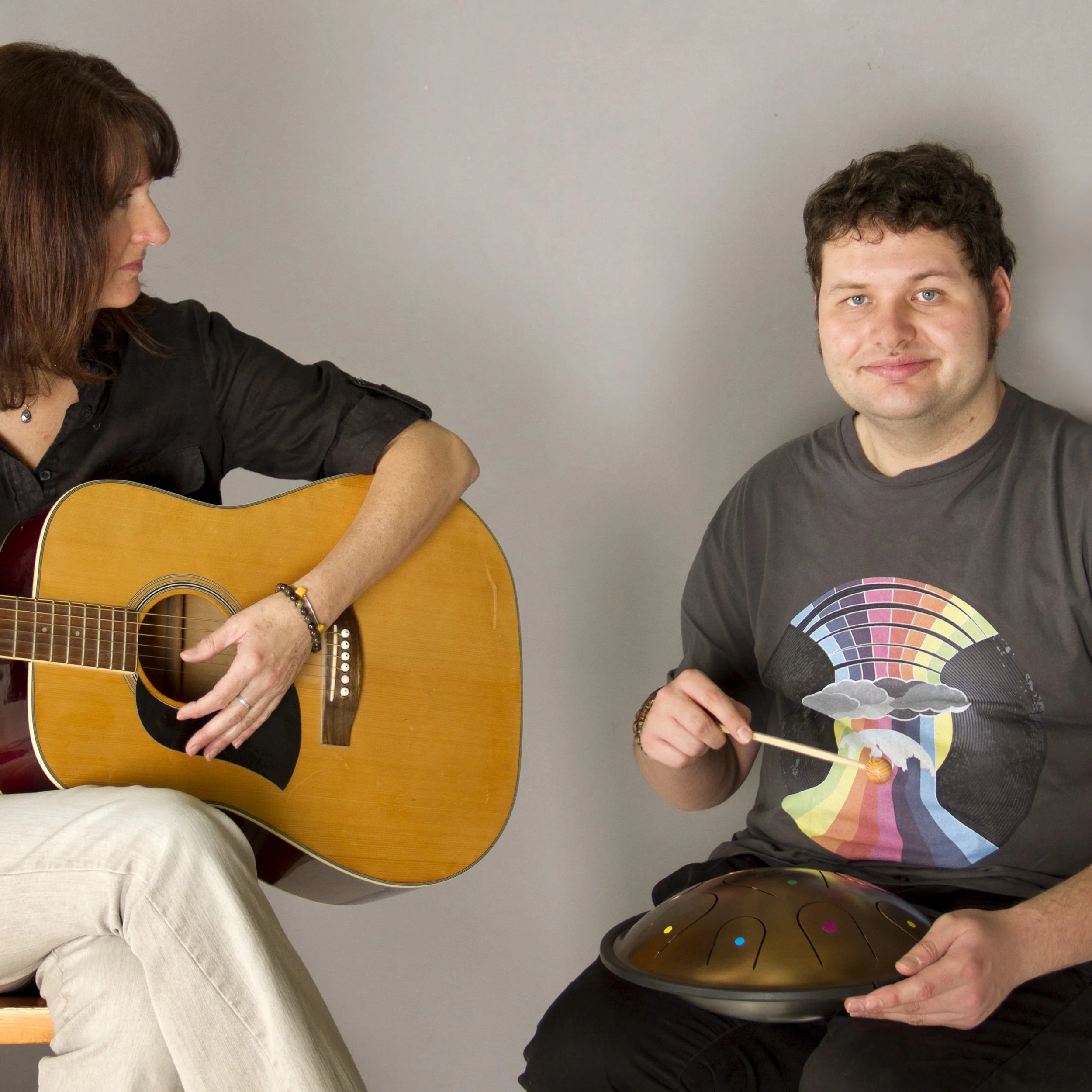
Caroline with Kyle in Their Shared Musical Field
Q. For those meeting you for the first time, how would you describe who you are?
My name is Caroline, and I’m the mother of a 39-year-old autistic nonspeaker.
I would say I’ve been on a crusade for the last 37 years to bring more awareness to autism in a much more holistic way, especially within the non-speaking world.
I’ve always known with Kyle that we communicate. You can call it mother’s intuition or instinct, but I’ve always known it was much more than that.
When he was first diagnosed 37 years ago, it was a very different landscape. We didn’t know much about autism. There were archaic ideas, including theories that blamed “refrigerator mothers”. There was stigma. There was misunderstanding. There was blame.
Thankfully, things have changed.
But yes, to answer your question simply, I’m a mother on a crusade.
And I’m not alone. Mothers like yourself have come into my orbit, all working to change the paradigm of how we perceive autism.
Alongside that, I’m a cranial sacral therapist. I’ve been a midwife. My personal philosophy has always been about awakening into awareness, continually becoming more aware of myself and how that awareness can support Kyle and others who come into my orbit.
That, in short, is who I am.
Q. You come from a military background. How has that shaped the way you move through life and motherhood?
Yes, I come from a long line of military, my father, my grandfather. Discipline was simply part of the air I grew up breathing.
Not strict in a harsh way, but structured. Grounded.
Kyle was also born into a military family, so that environment was present from the beginning.
What it has given me is form and structure. I’ve embodied that.
I sometimes look at younger mothers like yourself and think how far-reaching your perspectives are, how evolved the conversations have become around autism, telepathy, and the non-speaking world.
My role has been different.
My background has enabled me to lay down the train tracks. To build bridges. To stabilise the ship.
That’s very military.
I feel my role has been to create foundations, secure enough for others to take the baton and run further with it.
To open up new concepts and conversations globally.
Structure first. Expansion second.
Q. Thinking back to the very beginning, how early did you feel that connection with Kyle? When did you know something was different?
From the moment he was born.
I’ve had three children. A son just over a year older than Kyle, and a daughter a couple of years after him. So I had comparison.
But Kyle… from the delivery suite itself, I knew.
I knew he was going to take me on a very different path in parenting and in life.
He arrived extremely quickly. It was an accelerated delivery. And there was this sense, almost as though he was here, but not fully here. As though he’d arrived in the wrong dimension, or got off at the wrong bus stop.
That sounds dramatic, but that was the feeling.
It was almost panic. Not trauma exactly, but something unsettled. As though the timing or the placement was slightly off.
And yet he was a healthy baby. Nothing was fundamentally wrong.
But he needed me constantly.
We co-slept, which you absolutely did not admit to back then. You didn’t tell your health visitor you were doing that. But I had to. Otherwise neither of us would have slept.
He needed close contact. For the first nine months he was in a sling most of the time. I was hoovering, cooking, washing up, and he was attached to me.
Looking back, you might call it separation anxiety. But at the time, I just knew he needed me very close.
Q. When did you begin to notice developmental differences?
After his first birthday.
Up until then he had been reaching milestones. But I had Lewis as a template. Lewis was textbook. Sitting up at six months. Solids at eight or nine months. Very average progression.
Kyle wasn’t.
I know every child develops differently. But this felt different.
By around 15 months, the characteristics really began to set in.
And it happened quickly.
It took three days.
It was like someone had put a dimmer switch on a light and slowly turned it down.
In three days I went from the baby I knew to a baby I almost didn’t recognise.
No eye contact. Couldn’t bear to be touched. Spinning in circles. Couldn’t sleep.
And then he was in what I would describe as the fortress of his autism.
At that time, I didn’t know what autism was. My only reference was Rain Man. That was it.
Q. How did you move toward diagnosis?
We were stationed in Germany at the time.
Army life creates closeness. You move often. You’re far from extended family. So neighbours become family quickly.
I had a lovely neighbour whose niece had recently been diagnosed with autism. She gently said to me, “Caroline, I hope you don’t mind me asking, but do you think Kyle could be autistic?”
I had already been reading about it. No internet back then, of course. You had to go to a library, read books, gather information slowly.
And when I read the symptoms, I thought, yes. I think that’s what this is.
I took him to the doctor and said, “I think Kyle could be autistic.”
The doctor admitted he didn’t know much about it. But he trusted me. He said, “You’re his mother. Let’s refer him.”
The army specialists agreed. They didn’t know a huge amount either, but they listened.
And I’m very grateful for that.
Kyle’s diagnosis was quick. I didn’t have to fight for it.
Ironically, in those early days when very little was known, the process was in some ways more straightforward. There weren’t the same hoops to jump through.
At the time, I remember reading that perhaps 60,000 individuals in the UK were thought to have autism. It was seen as rare.
Very different to today.
Always Here Even When Unseen
Q. Were there supports in place at that time, or was that not really a thing back then?
Not really, not within the army.
We came back from Germany on a compassionate posting to Tidworth, which is a large garrison town. Because I already had Kyle’s psychiatric and psychological assessments, along with his speech and language reports, I was able to move fairly quickly.
I managed to get him into a very good school. In hindsight, I realise how fortunate that was.
Kyle went to a school for severe learning disabilities that had an autistic unit. They had just started introducing the Teach programme from the United States.
Teach created small classrooms, no more than five or six students. They had individual workstations to reduce distraction. There was structure, visual systems like PECS, and modified curriculum delivered in very focused ways.
It worked.
Kyle was well taught. He can read and write. His maths is excellent.
Whatever those early years provided him, they gave him a strong foundation, despite him being nonverbal.
Q. Why do you think that model isn’t more widely used now if it worked so well?
It worked not just for Kyle but for the other children too.
There were six in his class, one girl and five boys, all at different points on the spectrum. Some had language, some didn’t.
Kyle was always described as having “islands of intelligence”. He likes learning. He needs stimulation.
Even though autism engulfed him in many ways, if you introduced him to something he was genuinely interested in, he thrived.
He loves numbers. He reads very well. His spelling is better than mine.
I always reminded myself never to assume that because he was autistic, he wasn’t capable.
He’s 39 now, and I still look for ways for him to learn, develop, and enjoy new things. His life isn’t passive. It’s not about sitting and colouring in all day.
He is far more capable than people would assume.
Q. I know he loves music. When did that become clear?
Music has always been around him.
His father was a musician. I grew up with music. My mother and grandmother were piano teachers. I was in bands when I was younger, then I had to “get a proper job”.
So there was probably something innate in him. It was in his bones, in his blood.
But what surprised us was the level of ability.
He has perfect pitch.
He plays keyboard and guitar. He keeps impeccable rhythm on a drum. His musical memory and timing are phenomenal.
If he’s learning a new song, he knows exactly when to come in. If he’s playing chords for a track he’s recording, he gets it almost immediately.
He also loves performing.
Which is extraordinary, because many autistic individuals don’t enjoy that exposure. But Kyle steps in front of a microphone and is completely in purpose. No nerves. Just focus.
He’s a recording artist. He has albums out. He can spend hours in a studio, working something over and over until it’s right.
And he knows when it’s right.
When we finish a final recording, I can see it in him. That satisfaction. He knows we’ve nailed it.
Q. How did music therapy open that world up?
When we moved from Hampshire to Cornwall about 17 years ago, it was partly because of his severe hay fever. The coastal air helped.
The move was dysregulating for him. Everything changed.
College didn’t work well. He was done with that environment. I wanted something more enriching for him.
Cornwall is very creative. Someone suggested music therapy.
About 14 or 15 years ago, we started working with Corinne, who still comes twice a month. She’s practically family now.
I remember her first session vividly.
She laid out instruments, keyboard, chimes, xylophone, and asked Kyle if he’d like to play.
He sat down and spontaneously began playing Dream, Dream, Dream and other songs from memory.
She came into the kitchen and said, “You need to come and listen.”
There he was, singing and playing chords.
We had no idea that level of ability was in there.
That was the beginning of discovering his musical world.
Music therapy became a powerful outlet for him. It allowed him to communicate emotion through song choice and rhythm. There was an entire archived library of music inside him.
You could tell how he was feeling by what he chose to play.
It was fascinating.
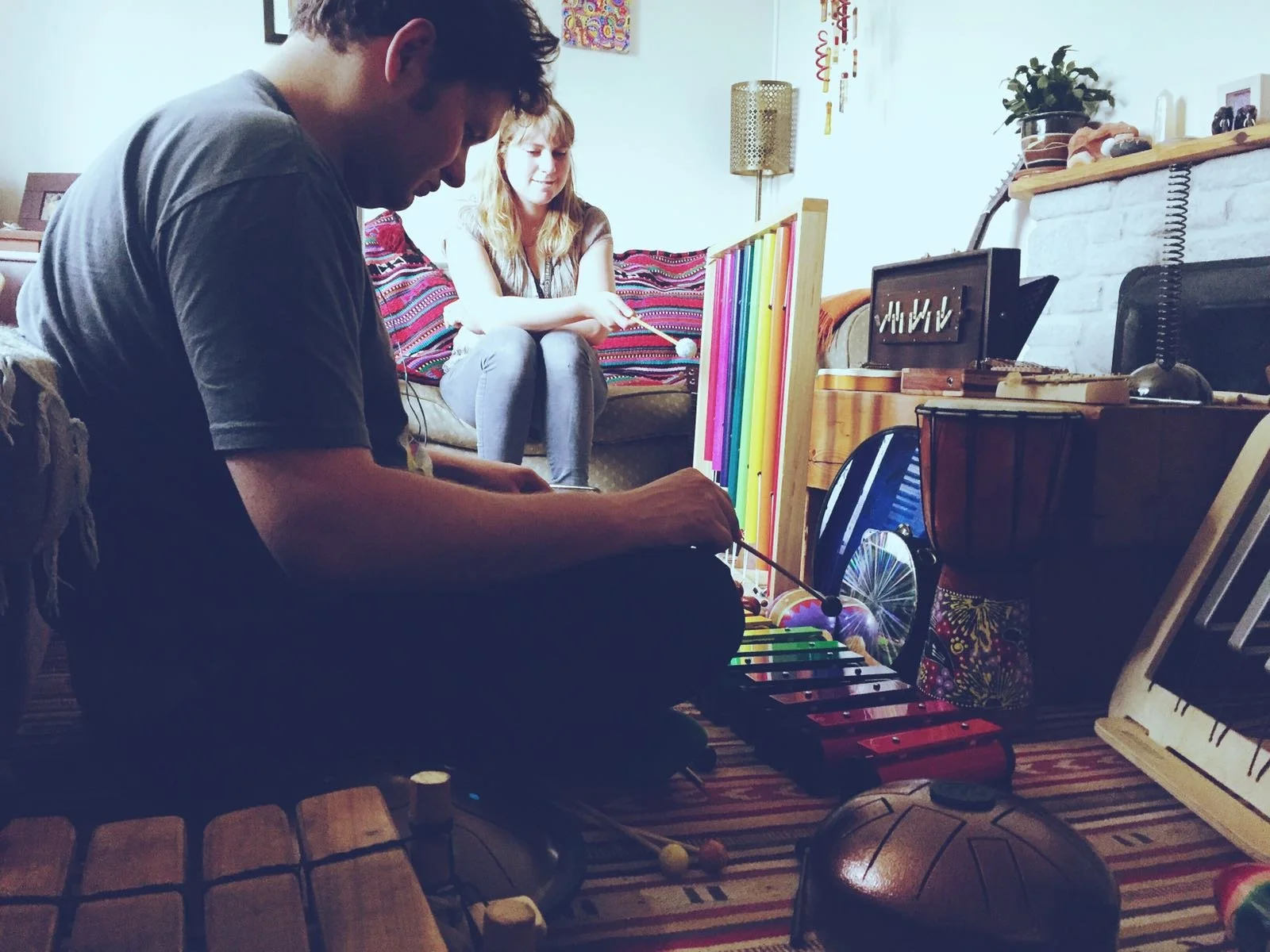
Kyle, in his own Rhythm
Q. When did you first recognise that what you were experiencing wasn’t just intuition, but something more, something telepathic?
I think I was doing it when he was very young.
But I wouldn’t have called it telepathy back then. I wouldn’t have had language for it. I was in survival mode, meeting his needs the best I could.
Even his father didn’t quite have the same light receptors, if you like.
As a mother with a young baby, there’s oxytocin driving that bond. And now there are studies linking oxytocin with telepathic connection. I have a theory that mothers of nonspeakers may have heightened uptake of oxytocin, because we have to maintain that connection. We don’t have another means.
But back then, I didn’t analyse it.
I just knew.
Kyle was hypersensitive. I felt like I wanted to put a force field around him. There was something very private and contained between the two of us.
Teachers would say, “It’s almost as if Kyle is reading our minds.”
And I would think, yes, he is.
If I wasn’t in a good mood, he reacted. So I learned quickly that I needed to regulate myself.
If I was calm, he grounded.
If I was dysregulated, he destabilised.
Q. So you were aware very early that he could sense your emotional state?
Yes.
And I began regulating by design, not by default.
I’ve heard many mothers say the same thing now. There’s something in us that knows we must stabilise ourselves to stabilise them.
We become the grounding force. Like stabilisers on a bicycle.
Sometimes that regulation happened across a room. Sometimes from a distance.
If Kyle was at school and I sensed something wasn’t right, I would go into that space in my awareness and almost send him a signal.
Not remote viewing exactly, but focused intention.
Almost saying, “It’s alright, Kyle. I’m still here.”
Because I used to feel that when I wasn’t physically present, he experienced that as disappearance.
And perhaps I was feeling the same about him when he was at school.
Q. Does he ever regulate you?
Through music, absolutely.
When he plays, it regulates my entire system.
He can sing certain tones that bring me straight into presence. It’s beyond words. It’s resonance.
Corinne, his music therapist, jokes now that Kyle is the music therapist.
Music is our meeting ground.
It’s where we both enter coherence.
Q. Outside of music, what does your communication feel like now? Is it words, images, emotions?
It’s mostly feelings and images.
If I think about dinner, I might visualise sausages or spaghetti, and Kyle will respond with the word. He doesn’t really pick up on language directly, but he picks up on pictures.
I describe it in terms of bandwidth.
The first bandwidth is normal speech, here and now, language. That’s quite clunky.
The second bandwidth is visual. I send an image, he responds.
If we go further out, it becomes a shared field.
Less separate. More unified.
Language requires comprehension in a very structured way. Kyle doesn’t access comprehension like we do. But in images, or in resonance, there’s clarity.
Music operates in that wider bandwidth.
Q. Can you describe a moment where that shared field became very clear to you?
Recently, we were playing music together. Kyle changed the chords unexpectedly.
I had been playing a melody I liked and instinctively looked at Corinne, thinking I might adjust to match him.
And I heard, very clearly, “Mum, don’t change because of me.”
He was completely in his own agency.
That field, the musical field, is his home.
He doesn’t need me to correct or support him there. He is equipped.
In that moment, it felt like I had entered another new space. We were all autonomous, yet observing one another at the same time.
It was shared, but not merged.
And that felt new.
Q. When you described that musical moment, it sounded like you were both simply allowed to be in your own space, without needing to fix or guide anything. Would that be right?
Yes.
In music there’s something called entrainment. When musicians play together, they begin to synchronise naturally. Psychology calls it the relational field.
But this was different.
This felt like pure observation.
Kyle knew exactly where I was in time and space. I knew exactly where he was. And the agreement was that I didn’t need to do anything other than be present in that resonance with him.
When he shifted from structured chords into improvisation, it was like jazz. You’re not sure exactly where you’re going, but you’re not lost either.
Kyle had complete command of that space.
He demonstrated what Steven May talks about when he says “presume competence.” Kyle wasn’t needing support. He wasn’t in therapy mode. He was autonomous.
My job wasn’t to care for him in that moment. It was to recognise his competence.
Afterwards, Corinne and I debriefed. She said, “Kyle had complete command of that space.”
Music for many people is entertainment. For Kyle, it’s environment.
It’s where he is at home.
And his competence levels there are beyond what I fully understand.

Autonomous. Present. Entirely Himself
Q. Where did lucid dreaming enter the picture?
Lucid dreaming began when Kyle was around eleven or twelve.
When he was very young, I would sometimes dream that he was about to wake up, and then I would wake, and then he would wake. But I wouldn’t call that lucid dreaming.
Lucid dreaming is when you know you’re dreaming while you’re in it.
You become conscious within the dream.
The first time it happened clearly with Kyle, it was as if he woke me up within the dream. Like he was saying, “Mum, wake up. I’m in here.”
And suddenly I realised I was dreaming with him.
In dreams, he’s fluent. He speaks beautifully.
He also appears in other people’s dreams. Practitioners, friends, members of our community. If he has a connection with someone, he visits them.
Over the years, he has come to me regularly in dreams.
Often we’re playing music. Sometimes he gives me words. Sometimes melody. Sometimes just the essence of a song.
When I wake, I capture it immediately. I’ll sing it into my phone, or play chords on guitar or ukulele to hold the memory.
I call that dream bridging.
It pulls the resonance of the dream into the physical day.
I’ll play it to Kyle and say, “Did you gave me this last night?”
And he nods.
There’s recognition.
Then we decide whether to develop it into a full song with the musicians he works with in the studio.
Kyle spends a lot of time in studios now. He’s very comfortable there.
Q. Some people debate or question this type of experience. How do you feel about that?
I actually think debate is healthy.
When the Telepathy Tapes gained traction, there were podcasts critiquing it, analysing it, questioning it.
I listened.
One psychologist described it as Kyle having agency in the dream space, and then I act as the agent in the physical world to bring it forward.
I thought that was a fair observation.
I’m not offended by questions.
I think it’s important that people ask how this works.
Blind acceptance isn’t helpful either.
But lived experience matters.
And for us, this is lived experience.
Q. You’re saying the dreaming allows Kyle to have agency, and you become the bridge in the physical world?
Yes, He gives me what I need to understand in dream time, and from that I can lay down the train tracks he wants laid. I can create opportunities so he can live his life with competence and purpose.
His purpose is music. Singing. Demonstrating that non-speaking individuals are highly skilled, intelligent, able people with dreams and aspirations like anyone else.
If I can build the structures, he can step into that fully.
Q. What are your intentions and hopes going forward, for both yourself and Kyle?
For me, it’s about continuing to stabilise this new way of viewing autism.
It’s about demonstrating the skills and abilities of non-speakers.
Kyle is an example that being non-speaking does not mean being incapable.
My intention is to keep providing opportunities for him to fully inhabit who he is and why he’s here.
Parallel to that, it’s about helping parents find their voice.
None of us can do this alone. But when you reach critical mass, the voices become stronger.
What you’re doing, Monique, what I’m doing, what others are doing, it’s all contributing to a shift.
I’m 61 now. I’m not young, not old, but I feel a responsibility to continue holding space.
We run a Facebook group. I have a TEDx talk coming up. I know what I want to say, but putting it into a script is another thing entirely. I may just have to shoot from the hip and trust they’ll edit it afterwards.
More than anything, I want to continue creating space for mothers, especially, to come forward and have candid conversations.
I’ve started referring to it as enhanced communication rather than telepathy. That feels more accurate to me.
This isn’t about fantasy or hopefulness. It’s about lived experience.
And while some will still question it, I think that minority is shrinking.
The movement feels collective now.
Telepathy isn’t just a trend. It isn’t something we jump on and then move past. It has opened something.
But the real work must return to the non-speakers themselves.
Systems still don’t meet them deeply enough. There are structures that need to change.
If we keep bringing awareness, if we keep speaking clearly and calmly, that shift will continue.
Q. Is it about systemic change then, not just personal experience?
Yes.
The change isn’t going to be made for us. We have to make it.
We understand our children better than anyone. Better than the experts. We live with them. We gave birth to them. We intuit them. We are in the field with them.
If a child’s needs are not being met within the system, then the system must evolve.
There is only so much you can do for a child within a narrow framework. So the question becomes, how do we understand children differently?
We must start meeting them on a deeper level. A more encompassing level.
There has been progress, especially in the last ten years. That’s positive. But there is still a long way to go.
We cannot keep looking through a narrow bandwidth when we’re trying to understand non-speaking children.
Through our Facebook group and our Zoom calls, we’ve heard from parents whose non-speaking children want to go to university. They are bright, academic, intelligent individuals.
So the question becomes: what are we going to do about it, as a society?
We must keep bringing this forward until it is fully witnessed and seen.
And I believe we are in that process.
The more of us who advocate, who speak clearly and calmly, the more this becomes undeniable.
Q. What would you say to other parents who feel this too?
Support each other.
Remain discerning. Remain impeccable in what you’re doing.
The old system thrives on separation, competition, conflict.
But the non-speakers operate in a resonant, coherent field.
So we must do the same.
We each hold our own purpose, but we work together.
That is how momentum builds.
Q. And finally, how do you feel about the future?
I feel hopeful.
When you have a life purpose, you can’t ignore it. It carries you through the difficult days. There’s something bigger supporting you.
We are juggling a lot as parents. But we are here for a reason.
And as long as we trust that, and support one another, this movement will continue to grow.
This is not a trend, it’s evolution.